Slot Mechanics: RTP, Volatility, and Max Win Explained 2026
When you strip away the flashing lights, the cascading reels, and the immersive soundtracks, every online slot machine is built on a mathematical skeleton. For the casual player, slots are a game of luck. For the informed player, they are a game of probabilities. In this guide, we break down exactly how RTP, Volatility, and Max Win are calculated, how they interact with one another, and how you can use this data to choose the right game for your playstyle.
What to Expect on This Page
1. RTP (Return to Player): The “Price” of the Spin
RTP stands for Return to Player. It is a percentage that indicates the theoretical payout of a game over a massive sample size (usually billions of spins). However, most players misunderstand how this applies to their daily session.
The Great RTP Misconception
If a slot has an RTP of 96%, many players believe that if they deposit and wager 100 units ($, £, €, or any other currency) they will walk away with 96 units. This is fundamentally wrong. In reality, the RTP reflects a “Cost Per Spin”: The player theoretically loses 4 units per spin.
Of course, RTP does not predict what happens in a short session. In the short term, variance rules; you could lose your entire 100 units, or you could turn it into 10,000. We will explore this further in the volatility section.
To understand RTP correctly, you must view it as the price of play.
- The Math: An RTP of 96% means the “House Edge” is 4%.
- The Cost: Mathematically, every time you bet 1 Unit (be it £1, €1, or $1), you are “paying” the casino 0.04 to play that round.
Think of it this way: When you press the spin button with a 1 unit bet on a 96% RTP slot, the math dictates that 0.96 is thrown back into the random prize pool, and 0.04 is instantly retained by the casino as their fee.
Of course, you cannot physically win 0.96 units on a single spin. You will either win nothing (losing your 1 unit) or win a multiplier (e.g., 5, 10, 100). But the Theoretical Loss remains constant: 0.04 units per spin.
While the percentage is verified over billions of spins, the mathematical formula applies to every single spin you make.
Webmaster’s Tip: This is why low RTP slots are so dangerous. A drop from 96% to 94% doesn’t sound like much, but it effectively increases the “cost” of every spin by 50% (from 4 cents to 6 cents). Over thousands of spins, this drains your bankroll significantly faster.
The Standards
- 98%+ (The Golden Tier): Games where the cost of play is minimal (e.g., Mega Joker, 1429 Uncharted Seas).
- 96% (The Standard): The fair market price for a video slot.
- Below 94% (The Danger Zone): You are paying a premium price for the same product. Avoid these unless the Jackpot potential justifies the cost.
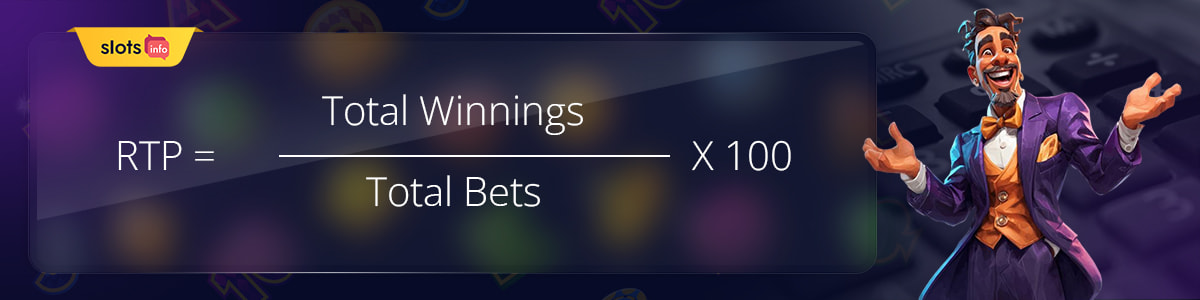
Why are there RTP ranges?
You might notice that the same game (e.g., Book of Dead) has a 96.2% RTP at one casino and a 94.2% RTP at another. This is known as Variable RTP, and the core idea behind it is actually legitimate:
The “Tax” Factor
When a country regulates online gambling, the government imposes taxes. In some jurisdictions, this tax is applied to the turnover (every single bet made) rather than just the casino’s profit.
If a casino has to pay a high tax on every spin, they cannot mathematically afford to offer a 96% RTP. The math model would break, and the casino would operate at a loss.
The German Example: This is the most extreme case. Germany imposes a very high tax on stakes. Consequently, you will rarely find RTPs over 90% in fully compliant German casinos. (Sorry, German players—this is a regulatory cost, not necessarily casino greed).
The Profit Factor
However, there is a second use case for ranges that is less about survival and more about profit margins.
Game providers (like Play’n GO, Pragmatic Play, or Red Tiger) offer casinos “tiers” of RTP (e.g., 96%, 94%, 91%). If a casino operates in a jurisdiction with reasonable taxes but still chooses the 94% setting over the 96% setting, they are making a conscious business decision to increase their “House Edge.”
Webmaster’s Advice:
Always check the ‘?’ or ‘i’ section of the slot. If you are not in a high-tax region like Germany, but the casino is serving you the 91% or 94% version, you are paying a “premium price” for no reason.
2. Volatility (Variance): The “Personality” of the Slot
If RTP is the price of the game, Volatility is how the game delivers its excitement. It measures the risk involved and the distribution of payouts.

Knowing the volatility is essential for Bankroll Management.
Low Volatility
- The Experience: Smooth sailing. You will see frequent winning animations and constant “pings.”
- The Math: The game pays out often, but the wins are usually small (often 0.5x to 2x your bet).
- The Strategy: Perfect for players with a smaller bankroll or those trying to clear a wagering requirement.
- Classic Example: Starburst (NetEnt).
On slots.info, we refer to players that prefer low volatility as “Casual Players.”
Medium Volatility
- The Experience: A balanced rollercoaster. You will endure some dry spells (dead spins), but the game is programmed to throw in mid-sized wins (15x – 50x) to keep your balance healthy.
- The Strategy: The best choice for the casual player who wants a fair shot at a decent win without risking their balance too quickly.
- Classic Example: Gonzo’s Quest (NetEnt) or Wolf Gold (Pragmatic Play).
Such players are called “Action Players” on slots.info.
High / Extreme Volatility
- The Experience: “Feast or Famine.” You might spin 50 times and win absolutely nothing. The base game can be brutal.
- The Math: The RTP is heavily concentrated in the Bonus Features. You are essentially paying for dead spins in the hopes of hitting a single, massive multiplier.
- The Strategy: Requires a large bankroll and nerves of steel. You are playing for the “1 in a million” potential.
- Classic Example: San Quentin (Nolimit City) or Peking Luck (Pragmatic Play).
We refer to high / extreme volatility players as “Thrill Seekers.”
3. Max Win (Exposure): The “Capped” Reality
The Max Win (or Max Exposure) describes the absolute limit a slot machine can pay in a single round. In the past, slots were limited only by the symbols on the reels. Today, virtually all high-volatility slots have a Hard Cap. If a game has a max win of 10,000x and you are in a bonus round that hits a 12,000x multiplier, the game will essentially “short circuit.” It will pay you the 10,000x and end the round immediately.

Probability vs. Possibility
This is the most overlooked stat in gambling. A provider might advertise a “50,000x Max Win,” but what are the odds of hitting it?
- Realistic Max Win: Some slots hit their cap once every 1 billion spins.
- Achievable Max Win: Others (like many Hacksaw Gaming or Pragmatic slots) might hit their cap once every 1 million spins.
The max win has further implications. The higher it is, the lower the probability of hitting it. If a max win is 100,000x your bet, it is statistically unlikely to occur. The reason is the RTP balancing out the potential. The slot is programmed to keep the house edge (as described in the RTP section). Since the money for very high max wins must come from somewhere within that mathematical model, it becomes increasingly unrealistic to hit such high caps.
At Slots.info, we always look for the Win Probability data. A 5,000x max win that actually happens is better than a 300,000x max win that has never been triggered in history.
4. Hybrid Models: The “Golden Ticket” Slots
We have established a general rule: High Max Win usually requires High Volatility. But if you browse our database, you will find anomalies. There are slots with Medium or even Low Volatility that still boast a Max Win of 10,000x or more.
This seems mathematically impossible. If a slot pays out frequently (using up a large portion of the RTP on small wins), where does the money for a massive 10,000x jackpot come from? How can a game be “safe” for your bankroll but still offer life-changing potential?
Developers use three specific math tricks to engineer these “Hybrid Models.”
a) The “Black Swan” Probability
This is the most common method in modern slots. The game is designed to play like a standard Medium Volatility slot. You get frequent wins, decent playtime, and usually hit wins of 50x–200x in the bonus rounds.
- The Trick: The “Max Win” is technically possible, but the probability is set to something astronomical, often 1 in 1 billion spins. Because this event is so rare, it costs almost nothing in terms of RTP allocation (perhaps 0.01%). This leaves the remaining 99.9% of the RTP to be distributed as frequent, medium-sized wins.
- The Reality: You are playing a Medium Volatility game that happens to carry a microscopic “Lottery Ticket” chance of a max win.
b) The Exponential Multiplier
This is often seen in Megaways™ slots or games with cascading reels.
- The Trick: These games often feel like Medium Volatility because the cascading symbols give you lots of small, frequent wins that keep your bankroll alive. However, the bonus round usually features an Unlimited Win Multiplier.
- The Math: Theoretically, if you get extremely lucky and hit 50 cascades in a row, the multiplier climbs to 50x, creating a path to a 20,000x win. The “Theoretical Ceiling” is massive, but the “Practical Ceiling” for 99% of players is much lower.
c) The Gamble Mechanic
Some slots lower their inherent volatility by allowing the player to take the risk manually.
- The Trick: The base game is Low/Medium Volatility, paying out frequent, small amounts. However, the game offers a “Gamble Feature” (e.g., Guess the Card, or Gamble your Free Spins for more spins).
- The Math: The slot outsources the volatility to you. The game itself is low risk, but if you choose to gamble a 100x win five times in a row, you artificially create your own High Volatility experience and your own Max Win potential.
5. Putting Theory into Practice: Bankroll Management
Knowledge of RTP and Volatility is useless if you do not apply it to your wallet. To play smart, you must match your budget to the math model of the game.
Here is the Slots.info strategy guide:
For the “Casual Player” (Small Bankroll)
If your goal is entertainment—to play for an hour or two with a deposit of 50 units—you must respect the variance.
- The Trap: Playing a High Volatility game (like San Quentin) with a small bankroll is statistically suicidal. These games can easily go 50+ spins without a meaningful win. With a small budget, you will likely hit 0 units before you ever trigger a bonus feature.
- The Fix: Stick to Low Volatility slots. These games are programmed to pay out frequently (even if the wins are small), effectively “recycling” your bankroll. This creates the “Time on Device” factor, giving you more playtime and a better sensation of winning.
For the “Action Player” (Medium Bankroll)
This is the most common playstyle. You want a balance: decent playtime, but a real shot at a 500x or 1,000x win. You should stick to Medium Volatility slots.
- The Trap: Beware of “Hybrid Models.” As an Action Player, you might see a Medium Volatility slot with a 50,000x Max Win and think you found the Holy Grail. This is a trap. In these games, the 50,000x is virtually impossible to hit (The “Black Swan” effect). You are better off playing a standard Medium Volatility slot with a 5,000x Max Win, where the math model actually gives you a realistic chance of hitting the top prize.
- The Fix: Check the “Win Probability” if available. Don’t be blinded by massive Max Win numbers if the volatility is listed as Medium.
For the “Thrill Seeker” (Large Bankroll)
If you are chasing a 10,000x+ win, you must accept that it requires a massive sample size of spins.
- The Reality: High Volatility slots hide the majority of their RTP in the bonus rounds. To access that RTP, you have to survive the brutal base game.
- The Math: You cannot judge a High Volatility slot on 100 spins. To have a statistical probability of triggering the main features and realizing the math model, you often need to commit to thousands of spins.
- The Rule of 500: A good rule of thumb for high variance slots is to have a bankroll of at least 300x to 500x your bet size. If you only have 100 units, do not bet 1 unit per spin. Drop your bet to 0.20 to ensure you can survive the dry spells.
The Slots.info Verdict: How to Choose?
To pick the right slot, you must look at how these three numbers interact. This is the Math Model Ecosystem:
- The Bonus Hunter: Look for High RTP (96.5%+) and High Volatility. You want the game to return as much money as possible, concentrated in big hits.
- The Entertainer: Look for Medium Volatility and Standard RTP. You want your 20 unit deposit to last for an hour of gameplay.
- The Jackpot Chaser: You generally have to accept Lower RTP (94-95%) because a portion of your “Cost Per Spin” is funding the Progressive Jackpot.
Final Thought: Remember that the “Cost Per Spin” applies to every round. Whether you win or lose today, the math is always working in the background. Choose the games that give you the best price (RTP) and the right thrill level (Volatility) for your money.

Maxime took over slots.info in 2025 and is an avid slots player and loves sports. His biggest problem is how to find time to combine all activities. You can accompany him on his way to become a successful webmaster and streamer.
FAQ
We covered all the essentials regarding the best online slots and how to recognize them. If you have any questions left, check our detailed FAQ section below. We’ve answered our readers’ most popular queries.
Does a higher RTP guarantee I will win?
No. A higher RTP simply means the casino has a smaller mathematical advantage over the long run. Short-term luck is still the deciding factor.
Can casinos change the RTP of a slot?
Yes and no. They cannot change it on the fly during your session. However, game providers offer different RTP versions of the same game to casinos. Always check the game rules ‘?’ or ‘i’ button to see the active RTP.
Is High Volatility better than Low Volatility?
It depends on your goal. High Volatility offers bigger win potential but higher risk of losing money quickly. Low Volatility offers more entertainment time but smaller wins.
Is a Medium Volatility slot with a huge Max Win (e.g., 50,000x) a good choice?
Proceed with caution. The 50,000x cap is often a "Black Swan" event. Read our section on Hybrid Models and the "Black Swan" trick to understand why the probability is often 1 in 1 billion, making the max win virtually impossible.
How much money do I need to play High Volatility slots?
High Volatility slots are risky. To withstand the dry spells (dead spins) and have a statistical chance of triggering the bonus features, we recommend a bankroll of at least 300x to 500x your bet size. See our Bankroll Strategy guide for more details.