Charles Fey and the Invention of the First Slot Machine
 Last Updated: 06 Aug 2026
7 min read
Last Updated: 06 Aug 2026
7 min read
The first slot machine came out of a small San Francisco workshop run by a Bavarian immigrant named Charles Fey. His three-reel Liberty Bell set the pattern that slots still follow more than a century later. Stay tuned to read all about the invention of the first ever slot machine.
Who Invented the First Slot Machine?
Charles Fey invented the first slot machine in San Francisco. His Liberty Bell was the earliest machine to combine spinning reels with an automatic payout, and that pairing still defines a slot today. Video slots swapped the hardware long ago, but the game underneath has never changed.
Fey was not the only builder chasing the idea. Sittman and Pitt, a Brooklyn firm, had released a popular poker machine in 1891, but its 50 cards spread over five drums created too many outcomes for any mechanism to score, so winners collected drinks or cigars from the bar.
Another local builder, Gustav Schultze, had machines that paid out on their own, but they were built around lottery-style wheels rather than reels. Nobody had joined the two halves yet, and the technical race was happening in San Francisco, not in the gambling halls of the East.
Fey had built several early machines of his own, including one based on the popular lottery game 4-11-44. Each one taught him something, and his Liberty Bell was the design that put those lessons together. The story of how he got there starts an ocean away.
Charles Fey’s Road to San Francisco
Charles Fey, the youngest of 15 children, was born in 1862 in Vöhringen, a small farming village in Bavaria. He was baptized August Fey and later changed his name to Charles, reportedly because he hated being called Gus. At 15, he left home to make his own way.
He worked his way across Europe in the years that followed. A factory in France that made intercom equipment taught him fine mechanics, and a later stretch in England added scientific instruments to his training. It was an odd resume for a future slot builder, but the skills carried over.
Fey crossed to America in 1885, landed in New Jersey, and kept moving west until he reached San Francisco. The city suited him: a former gold-rush port that had grown into a town of sailors, saloons, and easy spenders, where a skilled mechanic could always find work.
He repaired equipment at the California Electric Works, where he met Theodore Holtz, a fellow German immigrant, and the two later opened their own instrument shop. A tuberculosis diagnosis nearly stopped him, but he recovered, and after hours he tinkered in the basement where the first slot machine began.
A City Full of Coin Machines
San Francisco in the 1890s was packed with coin-operated novelties. Saloons kept trade stimulators, strength testers, fortune tellers, and card machines on their counters, anything that turned a spare nickel into a minute of suspense. Owners were quick to try any device that paid its way.
The machines were profitable, and the city tolerated them. San Francisco treated gambling loosely by the standards of the era, and a device that took nickels drew far less attention than a card table. Money moved fast there, and a counter machine caught some of it.
Gambling machines shared one weakness, though. A player who hit a winning combination had to wait for the bartender to check the reels and hand over the prize, which meant slow payouts, frequent disputes, and room for dishonest counting. To a trained mechanic, it looked like a design fault.
Inside the Liberty Bell Slot Machine
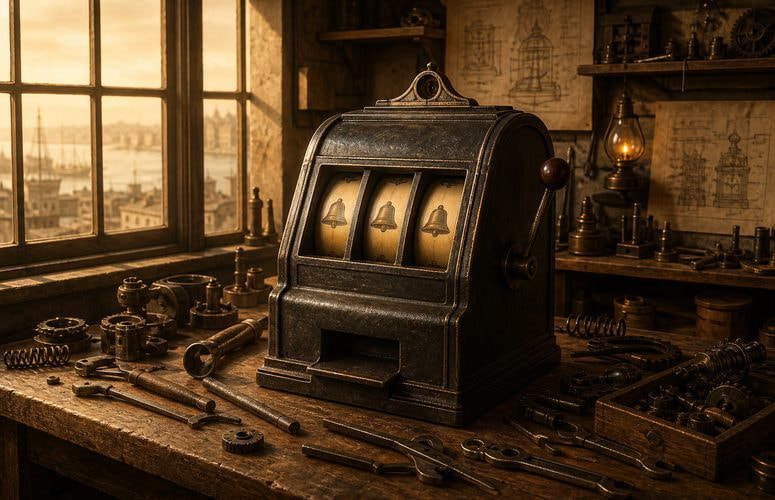
Fey’s Liberty Bell was a heavy cast-iron box with three reels, a coin slot, and a lever on the side. Pulling the lever set the reels spinning, and they clicked to a stop one at a time, a small piece of theater every slot since has kept.
Each reel carried a short list of symbols: horseshoes, hearts, diamonds, spades, a star, and a cracked Liberty Bell borrowed from the icon of American independence. The playing-card suits were a leftover from the poker machines it replaced, but the bell was the one that gave the machine its name.
Three bells in a row paid the top prize of 10 nickels, and the machine counted them out itself, with no bartender involved. The automatic payout was the real invention, and it worked because reels this simple produced few enough outcomes for the mechanism to score.
The automatic payout created a fresh problem, because a machine nobody supervised was easy to feed with slugs and fake nickels. Fey answered with a detecting pin inside the Liberty Bell, a small device that could separate genuine nickels from the counterfeits players pushed through the slot.
The trimmed-down, three-reel format became the standard for decades, and even the name helped the machine spread. The Liberty Bell was a patriotic emblem every American recognized, and borrowing it gave a gambling device a respectable face that saloon keepers were happy to put on display.
Fey refused to sell his machines outright. He placed them in saloons across the city and split the takings with each owner, so every Liberty Bell remained his property. Demand soon outran anything his workshop could produce, and saloon owners waited for a spot on the list.
When Was the First Slot Machine Invented?
The first slot machine was invented in the mid-1890s, though no one can name the exact year. Estimates run from 1887 to 1899, and Britannica dates Fey’s first payout machine to 1894. The fog has a simple cause: Fey filed no patent and left few business records.
The 1906 earthquake and the fires that followed erased much of what remained, workshop and machines included. Only a handful of original Liberty Bells survive, and one sat for years in a Reno restaurant run by Fey’s grandsons. A dated ledger could settle the debate, but none has surfaced.
For now, the safest claim is the range itself, and the range matters less than it might seem. Whichever year is right, the Liberty Bell was earning nickels in San Francisco saloons by the turn of the century, years ahead of the machines that copied it.
The Machine Everyone Copied
Success brought imitators almost at once, and with no patent, Fey had no way to stop them. One often-repeated story claims a Liberty Bell was stolen from a San Francisco saloon in 1905 and ended up in a competitor’s factory. That competitor was Herbert Mills of Chicago.
His Operator Bell, produced from around 1907, copied the concept at a scale Fey’s workshop could never match. Machines of that era picked up fruit symbols and the BAR sign, tied to chewing-gum prizes used to sidestep gambling laws. Cherries, bells, and bars on classic reels date from this period.
Fey never stopped inventing. He kept refining payout mechanisms and built new machines for decades, including trade stimulators and draw-poker devices. He died in San Francisco in 1944, and while the fortune went mostly to other men, his bell had become the industry’s shorthand for a jackpot.
From the First Ever Slot Machine to Modern-Day Online Slots
More than a century separates that basement workshop from today’s online slots, yet the loop is unchanged. Players spin the reels, match the symbols, collect the win. Modern games now publish RTP, volatility, and max win figures, a level of transparency Fey never had to consider.
The machines themselves have kept a long memory. Bells, cherries, and bars still fill the reels of new releases, and the retro slots revival shows younger players choosing that authentic look on purpose. The pull Fey built into the first slot machine has not weakened.
Manuela is the Content Manager at slots.info, with six years in and around the online gambling industry and a soft spot for slots. She keeps everything factual and honest, with none of the over-the-top promises of life-changing wins.
Related Articles
 How to Pick a Slot Machine: A 7-Step Checklist Before You Spin
The right slot is the one that matches how you like to play, not the one with the loudest banner. A cautious player and a jackpot chaser should walk away with very different games. Knowing how to pick a slot machine comes down to a few numbers you can read in under a minute, and this checklist runs through all seven, so let’s get right into it.
 The Dog House Slots: Every Slot in Pragmatic Play’s Franchise Ranked
With barking dogs and wagging tails at the forefront, the dog house slots have been a fixture of online casinos since Pragmatic Play released the original in 2019. Eight games share the name, and this guide ranks them all by release date, with the main figures and review links for each.
 Every Slot in Hacksaw Gaming’s “Le” Series Ranked by Release Date
Hacksaw Gaming launched Le Bandit in August 2023, and that cartoon-styled heist kicked off the Hacksaw Le series. Seventeen games on, each keeps the same coin-collection bonus at its core but swaps in a new character and setting. The list below ranks every Le slot from the newest release to the oldest.